Ownership
- Reuse strategy
- Governance model
- Decision rights
- Exception handling
- Design principles and OKRs adopted across regions
Kimberly-Clark, Consumer Goods
Reframed a global standardization initiative from visual consistency into execution efficiency, decision ownership, and measurable cost reduction.
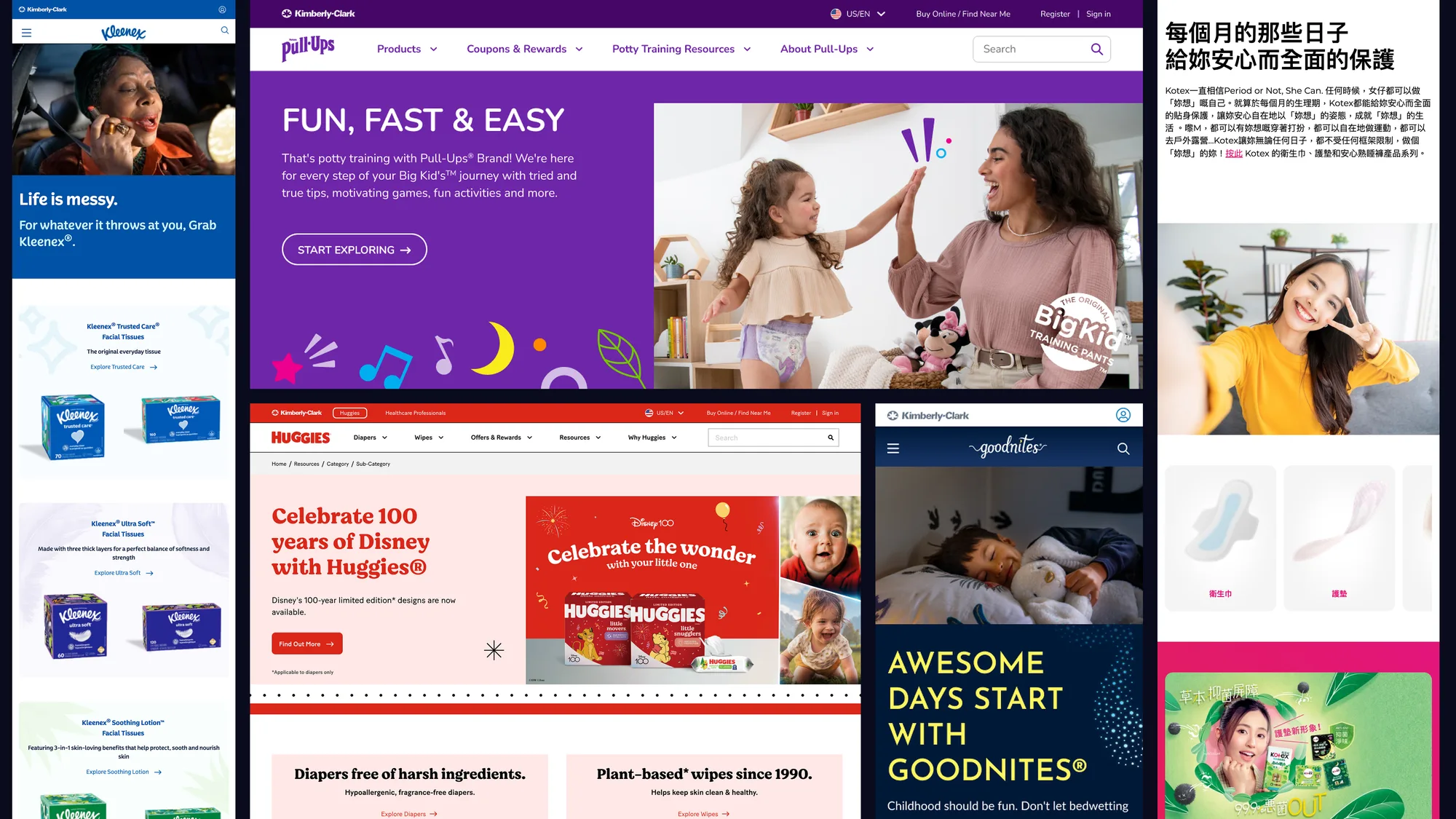
Core challenge
How do you standardize 400+ legacy websites across 30+ markets when speed and consistency are treated as a tradeoff, and no one owns the decision?
Consumer behavior was shifting faster than the organization could ship. Launches arrived late and lost relevance. The fragmented delivery model created engineering bottlenecks, repeated rework, and defect leakage across distributed teams and CMSs.
Speed and consistency were treated as a tradeoff. No standards existed, no one owned the decision, and design was reacting downstream instead of shaping execution constraints.
Owned the strategy, governance model, and decision rights that made reuse practical at scale.
I reframed the initiative from visual consistency to execution efficiency. Instead of asking teams to match a look, I formalized design decision authority and positioned design as a constraint-setting operating layer.
This meant defining reuse as an execution strategy and building governance rules, decision rights, adoption criteria, and exception handling. The tradeoff was explicit: local autonomy had to be reduced so teams could gain speed, predictability, and quality at scale.
Reduced local autonomy. Met with engineering pushback, accepted as the cost of speed at scale.
Required shifting from consensus-seeking to clear decision ownership.
I rejected incremental fixes, accepting short-term friction to solve a systemic execution problem.
Reuse strategy, governance rules, adoption criteria, and exception handling.
From reduced development rework via 93% component reuse
From standardized patterns and embedded governance
Single design system as execution contract across 400+ properties
Hiring, performance management, mentoring, career frameworks, and OKRs.
Led a 15-person distributed team of FTEs and contractors across Brazil, USA, and India. Coordinated contractors directly; influenced FTEs through structured mentoring, career frameworks, and OKRs.
Acted as escalation point between UX, Product, Engineering, and Business: scoping deliveries, driving alignment, and making trade-offs explicit before they became blockers.