Education, Independent
Creating the first product-driven Japanese learning platform in a teacher-driven market.
An independent product built on primary market research, pedagogical adaptation, and product-led growth for Brazilian learners whose study material runs out at intermediate level.
Core challenge
How do you create a product-led category in a market where every competitor sells a teacher's face, serious students measure progress by an official proficiency exam, and the Portuguese-language path ends halfway up the ladder?
Context and reality
The Brazilian Japanese-learning market is built entirely around teachers. Every competitor sells a face, a personality, and years of accumulated trust, on generic course platforms, pay-upfront at R$1,000-2,500, with no free layer and no behavioral data. Serious students organize their entire journey around the JLPT (the Japanese government's official proficiency exam, a five-level ladder from N5 at beginner to N1 at full reading fluency), yet no product treats it that way.
The deeper failure is structural: Portuguese-language material ends at intermediate level. Every competitor stops at N2 or below, most at N3, the intermediate plateau. Self-taught learners are forced to migrate to English guides or raw Japanese material halfway through the journey. I sized this market with primary data (JLPT registrations, 1,479 to 1,582 year over year), not generic EdTech multipliers: roughly 3,000 serious learners. Small, concentrated, and completely underserved.
The decision I took
Sole owner of every research, product, pricing, and go-to-market decision.
I bet on product in a market that only sells teachers. No face, no pop culture hooks, no gamification, no promise of fast fluency. A deliberate filter for serious adult learners. The positioning came from research, not taste: students who reach intermediate level are not hobbyists collecting streaks; they structure their lives around the JLPT and need a path that does not switch languages halfway.
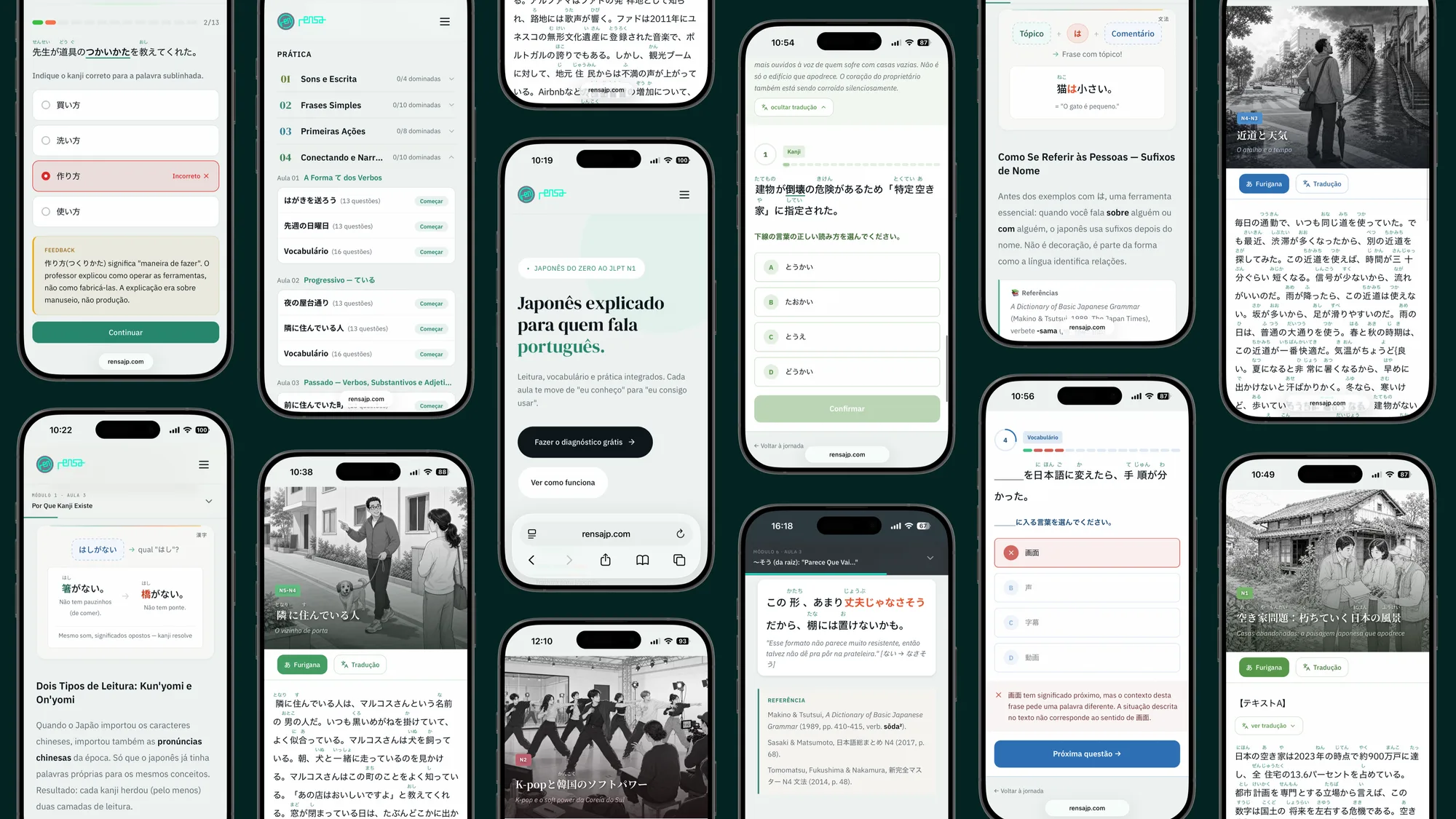
The pedagogy starts from Japan's most respected mastery-based reading tradition and adapts it to a context its originators never considered. That tradition assumes the student accepts starting from zero, rebuilding foundations patiently because the culture rewards discipline over speed. For a Brazilian adult learner studying a third language as a serious hobby, that assumption creates more friction than benefit. So I kept what works (disciplined progression, radical thematic variety, mastery gates) and corrected what does not: replaced mechanical repetition with comprehension testing, explained errors instead of just marking them, and lowered the mastery threshold from 100% to 80% to account for legitimate ambiguity in reading comprehension. Kanji appears from lesson one with furigana support, against the whole market's romanized-comfort consensus, because real reading ability is the product.
Business decisions followed the same logic. Building a proprietary platform instead of a Hotmart-style LMS was an economics call, not a technical one: 10-12% platform fees, zero behavioral data, and no control over experience, versus full ownership of all three. Pricing introduced recurring subscription to a pay-upfront market, modeled against real fixed costs. And when qualitative research revealed that students fear abandoning the hobby more than they fear the price, the model shifted toward guarantees over discounts.
Adapting a pedagogy built for cultural patience to learners who need visible progress sooner. The bet: 80% mastery with comprehension testing produces better readers than 100% mastery with mechanical repetition.
Bet on a faceless product in a market that only buys teachers, accepting slower trust-building in exchange for a structurally defensible position.
What changed
Market sizing, curriculum architecture, pricing model, and go-to-market.
Research that held
- Sized the market from primary JLPT registration data: roughly 3,000 serious learners in Brazil, concentrated and completely underserved past intermediate level
- Depth interviews with three learner profiles broke non-conversion into independent dimensions (continuity risk, level fit, timing), each demanding its own product answer
- A second sizing round sharpened the positioning: the advanced range works as credential and moat, while the serious beginner is the paying segment
Product bets
- Product-led funnel: 100% free grammar guide, reading diagnostic, and a paid layer with workbook, student analytics, and course personalization
- A diagnostic that measures how students process text, not their JLPT level, segmenting them into three reader profiles
- Mastery-based progression at 80%, integrated reading over isolated drills, anti-gamification throughout
Position created
- The only complete N5-to-N1 structured curriculum in Portuguese; the market's real ceiling is N2
- The only recurring subscription with mastery pedagogy in this market
- Early visibility in AI answer engines: assistant referrals already rival Google organic search as a discovery channel, before any dedicated effort
Outcomes
176 lessons mapped against official JLPT requirements. Every competitor stops at N2 or below; students migrate to English guides mid-journey
Three-layer freemium funnel in a 100% teacher-driven, pay-upfront market: free guide, reading diagnostic, paid workbook
2,136 kanji and 8,300+ vocabulary entries mapped by proficiency level, feeding every lesson, exercise, and diagnostic